Starting a daily journal is easy to plan and surprisingly easy to abandon. Time and motivation get the blame, but there is a third culprit people rarely name: the wrong kit. A notebook that refuses to lie flat, a pen that smears under your hand, paper so thin the ink shows through — small irritations, repeated daily, quietly kill the habit. Sorting the stationery takes an afternoon and costs far less than most hobbies. What follows is a practical checklist, working outwards from the notebook, so that your first entry is about writing rather than wrestling with your supplies.
Start with the notebook
Everything else is secondary. A journal you enjoy opening will get used; a beautiful one you avoid will not.
Size and format
A5 is the sensible default: enough room for a proper entry, small enough to sit on a bedside table or slip into a bag. A6 suits short entries and pockets. B5 and A4 give you space for long-form writing, mind maps or weekly spreads, but they get heavy the moment you carry them. If you plan to journal at a desk and only occasionally elsewhere, size barely matters. If you want the notebook with you, weigh it in your hand before buying.
Binding
Lay-flat is the single most underrated feature. Sewn and casebound notebooks, lay-flat perfect binding, wire-o spirals and discbound systems all open flat and stay open. Standard glued bindings often need a hand to hold them down, which makes handwriting tiring and left-handed writing worse. Check the binding before you buy: open the notebook to the middle and let go.
Paper
Look for a paper weight of roughly 80–100gsm for ballpoints, gel pens and pencils. Fountain pen users generally want 90gsm and above, or a coated paper that resists feathering. Thin, budget paper is where ghosting (seeing the previous page's writing through the sheet) and bleed-through come from. If you write on both sides of a page, buy once and buy thicker.
Ruling
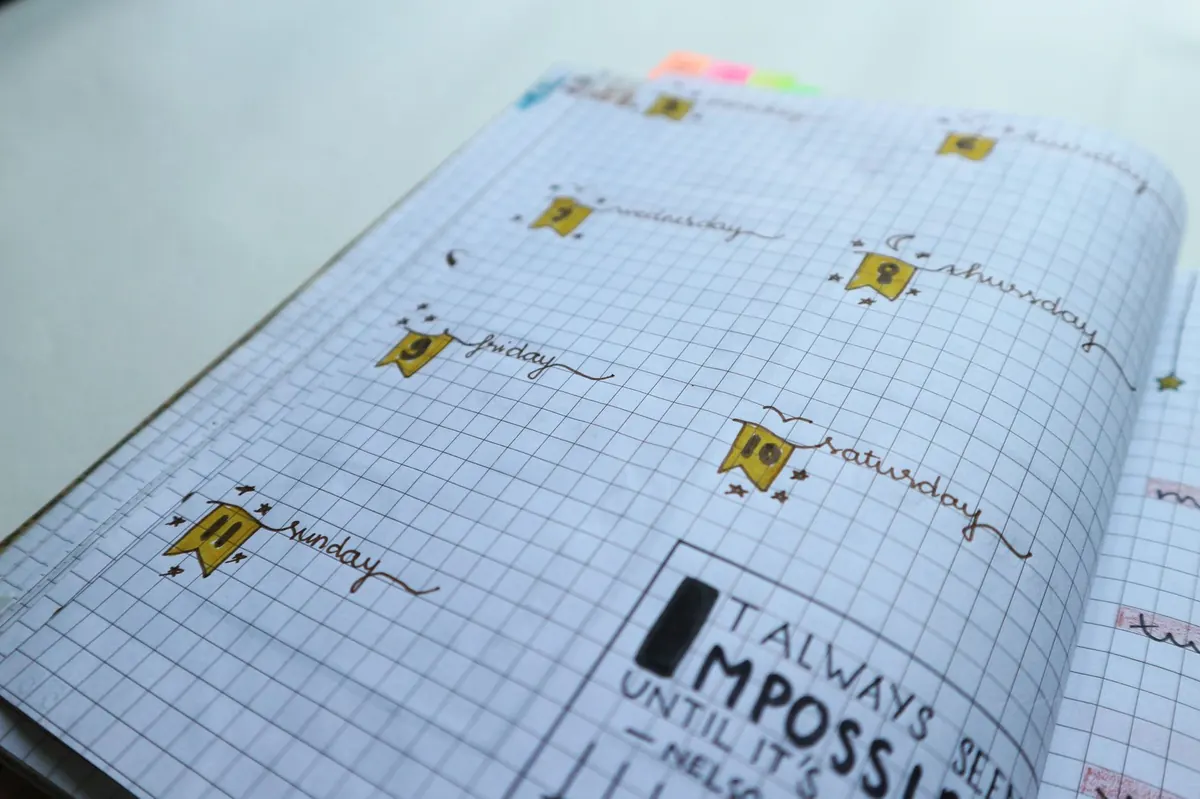
Lined paper suits prose and long entries. Dotted suits mixed use: lists, headers, sketches and boxes all work on it. Plain suits drawing and collage. Grid suits planners and trackers. Dotted is the compromise most journal writers eventually settle on, precisely because it does not force a format on the page.
Pens: choose by how you write, not how it looks
Take your three favourite pens and write a paragraph with each on the notebook's back page. That single test tells you more than any review.
- Fineliners (0.3–0.5mm) — crisp and consistent, good for small handwriting. Many are water-based, so check the drying time.
- Gel pens — smooth and dark, widely available in fine tips. Some smudge; quick-dry versions are worth seeking out.
- Rollerballs — wetter and darker than ballpoints, close to a fountain pen feel without the maintenance.
- Ballpoints — reliable, cheap, dry almost instantly and forgiving on thin paper. The pressure needed can tire your hand over a long entry.
- Fountain pens — lovely to write with, but the wrong ink on the wrong paper is a disaster. Keep a spare cartridge or a back-up pen.
- Pencils — an HB or 2B is useful for rough planning, sketching and anything you may want to revise.
If you are left-handed, drying time should outrank almost everything else. Fast-drying gel and rollerball inks, or a fine ballpoint, cause the least trouble. Blotting paper tucked into the back of the notebook helps with slower inks.
Highlighters, markers and colour
Highlighters are for finding things again, not for decoration. A mild or pastel highlighter in yellow, plus one contrasting colour, covers most needs without turning every page into a rainbow. Chisel tips let you underline and block-fill; bullet tips suit small handwriting.
Traditional alcohol-based markers often bleed straight through journal paper. Water-based brush pens and gel highlighters are usually safer, though gel highlighters can smear some gel inks and leave a waxy film. A fine-liner in a second colour is often more useful than three highlighters, particularly for headers and date lines.
Tabs, flags and page markers
Once you have more than a few weeks of entries, finding anything becomes the problem. Plan for that now, but do not over-tab on day one — nothing dates a journal faster than forty empty tabs.
- Adhesive index tabs for permanent sections: notes, quotes, gratitude, monthly reviews.
- Repositionable flags for temporary marks: follow-ups, ideas to expand, pages to revisit.
- Washi tape for making your own tabs, repairing torn edges and marking the current page.
- A ribbon or clip-on bookmark so the notebook always opens where you left off.
- A pen loop or elastic band if your notebook has no closure — the pen stays with the book, which matters more than it sounds.
The extras worth keeping within reach
A small pouch does more for consistency than any single item inside it. Keep the following together and the habit becomes frictionless:
- A pencil, sharpener and soft eraser for planning and sketching.
- A short ruler, for date margins, boxes and straight underlines.
- Correction tape rather than fluid, which is cleaner in a notebook.
- Blotting paper if you use a fountain pen.
- Spare cartridges or a back-up pen, so a dry pen never ends an entry.
- A second, smaller notebook for lists and errands, so the journal stays a journal.
Keep the kit in one place and the notebook in sight. Habit follows convenience far more reliably than willpower.
A starter checklist you can copy
If you would rather buy once, this is the short version.
- One A5 notebook with lay-flat binding and paper of at least 90gsm.
- A dotted or lined ruling, depending on whether you write prose or make lists.
- One main pen you have actually tested on the paper.
- One back-up pen, pencil or spare cartridge.
- One mild highlighter and one contrasting fine-liner.
- A pack of repositionable flags.
- A pen loop, elastic band or ribbon bookmark.
- A small pouch to hold the loose pieces.
Everything beyond that is optional. Wait until a real need appears — a section you keep flicking back to, a page you want to keep clean — before buying anything else.
Making the kit work day after day
Before your first entry, test each pen on the last page or inside the cover. Write on both sides of a sheet, leave it a minute, then rub it with your thumb. Any pen that smears, bleeds or feathers gets demoted to shopping lists. That five-minute test prevents months of quiet annoyance.
Then stop optimising. A journal is not a system to be perfected; it is a place to put things down. Keep the notebook somewhere you already sit — beside the kettle, on the bedside table, on the corner of the desk — and leave the pen on top of it. Write the date at the top and two sentences underneath, even on the days you have nothing to say. Two minutes still counts as an entry, and the streak matters more than the word count.
Finally, treat the supplies as consumables. When a pen runs dry, replace it with the same model. When the notebook fills, start the next one without redesigning your setup. The point of a stationery checklist is not to own the right things; it is to remove every small reason to skip a day until writing becomes the easiest part of your evening.
Photo: Karita88 / Pixabay