By the end of Freshers' Week you will own a lanyard, three takeaway menus and a notebook you never open again. The bullet journal is different. Not because it is cleverer than a planner, but because you build it page by page, so it only ever contains what your term actually needs.
The system is deliberately plain: number your pages, keep an index, and log everything in short lines with a symbol in front. A dot for a task, a dash for a note, an open circle for something to schedule. That is the whole method. What follows assumes you are starting with a blank notebook in September and want your deadlines, your spending and your sleep to live in the same place.
What you actually need
Stationery shops will happily sell you a small fortune in washi tape during your first fortnight. You do not need it. Start with:
- A notebook. A5, dotted or squared, with numbered pages if you can find one. Anything sturdy enough to survive a rucksack will do.
- One pen you like writing with. That is the minimum.
- A ruler and two highlighters, if you like a bit of structure — one colour for deadlines, one for personal things.
Leave the fineliners and fancy covers until January, when you know the system has stuck.
Set up four pages before term starts
Index and key (pages 1–2)
Number the first twenty pages or so by hand, then keep two pages at the front as an index. Write "Index" at the top of page one and "Key" at the top of page two. Under Key, list the symbols you will use: a dot for a task, a cross for done, an arrow for moved to tomorrow, a star for exams and hand-ins, a dash for a note. Keep it to five or six.
Future log (pages 3–4)
A two-page spread split into boxes, one per month of the academic year. Term dates, essay deadlines, exam periods, family birthdays and rent due dates go here. It is a map, not a plan.
Monthly log
A calendar down the left page, a task list on the right. The calendar holds appointments and social plans; the list holds things that need doing this month but not this week — renew the library book, book a dentist appointment, sort out a railcard.
Weekly spread
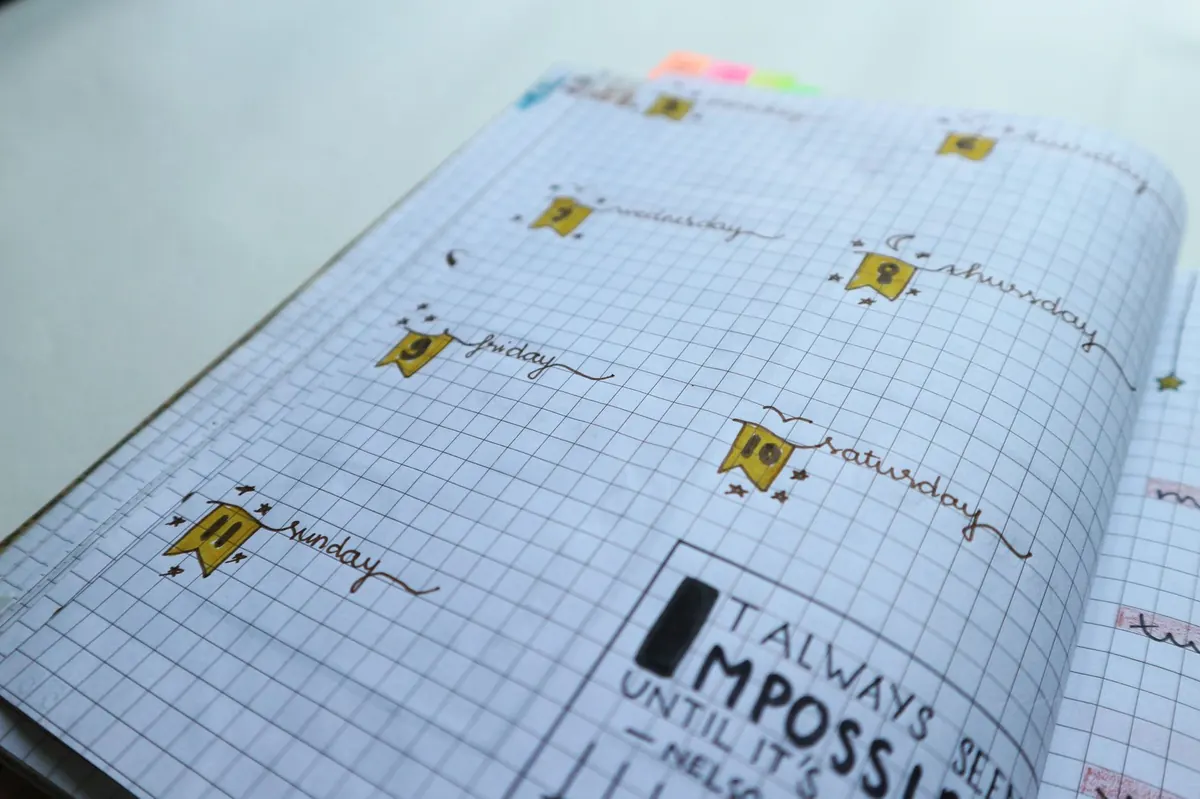
This is the page you will actually live on. A line for each day down one side, a short task list down the other, and space for notes. Some people prefer a daily page; try the weekly version for a fortnight before switching.
Deadlines: empty the handbooks once
Sit down in week one with your module handbooks and your university's online learning system open, and copy every assessment date into the future log. Not the essay title — the date and the word count. Something like: "Thu 14 Nov — PSY101 essay, 1,500 words."
Then set a Sunday routine. Ten minutes, tea in hand, copy the coming fortnight's deadlines onto this week's spread and mark the evenings you will start each one. A deadline you first see on the day is a deadline you have already missed; one you saw three weeks ago is a couple of comfortable evenings' work. Add a small square beside each entry and tick it when submitted — no planner app has managed to reproduce that particular satisfaction.
Revision: a log, not a work of art
Bullet journals go wrong when they turn into drawing projects. For revision, keep it functional.
Lecture and reading notes
Do not copy notes out again. Log the lecture, the date and the two or three ideas you would want in an exam, plus the page numbers of anything you read. If a topic needs more, give it its own page and add it to the index.
A topic tracker
Draw a grid with your module topics down the side and three columns across: read, notes, can explain it. Tick the third column only when you can talk a flatmate through the topic without looking at anything. Revisit a topic a few days after studying it, then again the following week — returning to material at intervals beats one long session, and the grid makes it obvious which topics you have been quietly avoiding.
Budgeting on a student income
Money is the part of university life that most planners ignore. Give it one page at the start of each month.
- Money in. Your student finance instalment, any bursary or scholarship, and the hours you expect from a part-time job.
- Fixed outgoings. Rent, phone, travel, subscriptions, society memberships. Write the numbers, not just the names.
- What is left, divided by the weeks in term. That rough weekly figure goes at the top of each weekly spread as your daily number.
- Daily spending. A dash and an amount: "– 3.40 coffee", "– 6.90 lunch". Small purchases are what quietly empty a term's money.
If money is causing real worry, speak to your university's student advice service or the Students' Union advice centre. It is free, confidential, and they deal with this every day — including hardship funds and payment plans you may not know exist. Go early rather than in the last week of term.
Wellbeing: three lines a day
You do not need a mood chart with twelve colours. Three lines at the end of the day will do: how you slept, one thing that went well, one thing to do tomorrow. On rough days, add a word for how you felt and a number out of ten.
Keep a "wobble page" too — the place for the tangled worry about a friendship, a seminar or a placement. Write it out, then write the smallest next step underneath. If low mood, anxiety or poor sleep lasts more than a couple of weeks, or you are not managing day to day, contact your GP or your university's wellbeing service. That is not an overreaction; it is what they are there for.
Keeping it going past October
Most journals are abandoned because their owners try to catch up. Do not. If you miss a week, turn to today's date and start there — no apology, no empty pages to fill in. Never rip pages out; the messy ones show what you were dealing with.
Two habits keep the whole thing alive. First, a ten-minute Sunday reset: new weekly spread, deadlines copied across, money total adjusted. Second, keep the notebook open on your desk rather than in a drawer, where it becomes invisible by week five.
If the full system ever collapses, keep two things going: a running list of deadlines and a record of what you have spent. Those two pages will carry you through even the busiest term, and the rest can wait until reading week.
Photo: Bich Tran / Pexels