How to Build a Portable Writing Kit for Commuting in the UK
The best writing kit is the one you actually carry. Not the leather-bound journal that stays on the desk at home, and not the fountain pen too precious to leave the house. Just a small, dependable set of tools that slips into the bag you were taking anyway. Get that right and the twenty minutes between stations stops being dead time.
Commuting in the UK has its own rhythms. A train from Leeds to Manchester, a Tube ride from Zone 3, a bus that lurches through Bristol, a ScotRail service in the rain. The kit has to survive all of it. It should be light enough to forget, tough enough to be shoved under a seat, and quick enough to open while you are standing up. Build it once, reset it weekly, and you will write more than you expect.
Start With the Bag You Already Carry
Do not buy a special writer’s bag. The best portable writing kit fits inside the backpack, messenger bag, tote or coat pocket you already use. If it needs its own separate luggage, it will stay at home. Test your bag by asking three questions: can you get the notebook out one-handed, can you close it again without looking, and can you do both while holding a rail on a moving Circle line train?
Most UK commutes involve a laptop, a water bottle, a packed lunch, an umbrella and a spare layer. Your writing kit has to live in the gaps. That means flat things, soft things and nothing that leaks. A small zipped pouch helps, but a large coat pocket works just as well. The point is not organisation for its own sake. The point is removing every excuse not to write.
- Keep it vertical. A notebook that slides in beside a laptop is easier to reach than one buried at the bottom.
- Keep it quiet. No rattling tins, no clicky pen you would not use in a quiet coach.
- Keep it weatherproof. A ziplock bag costs pennies and has saved more manuscripts than most writing apps.
The Notebook: Small, Flat, Replaceable
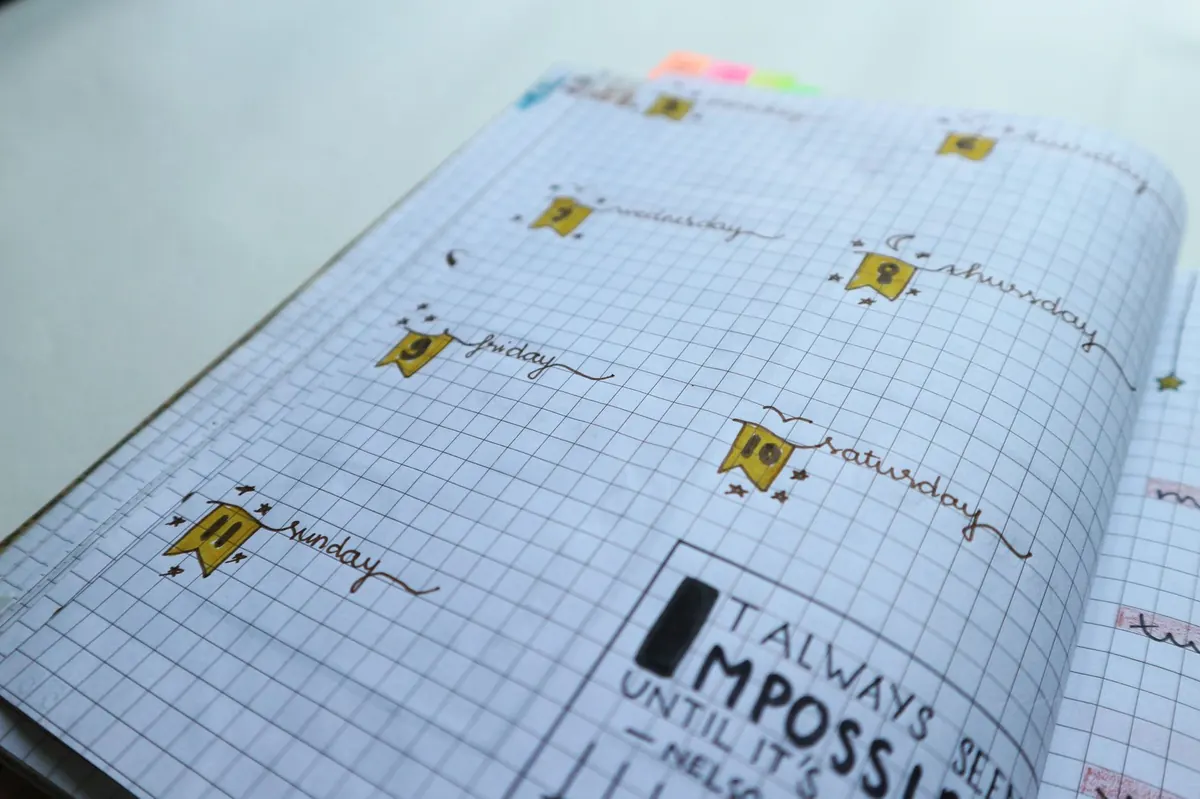
Choose a notebook you are willing to fill badly. A6 or A5, softcover, 80 to 120 pages, with an elastic closure and a back pocket. Moleskine cahiers, Rhodia pads, Leuchtturm notebooks and supermarket own-brand equivalents all do the job. Hardback notebooks look lovely but add weight and bulk. Thick notebooks feel important but take months to finish. A slim one gives you the satisfaction of completing something.
UK weather is the enemy of paper. Damp platforms, drizzle that gets into every gap, and the mysterious wet patch on the train table. A pencil is more reliable than a water-soluble ink. If you prefer pen, use a permanent or quick-drying ink and keep the notebook in a plastic sleeve. Rite in the Rain notebooks are excellent for the truly committed, but they are expensive and less pleasant for everyday drafting. For most commuters, a cheap notebook and a ziplock bag are enough.
Consider two notebooks, not one. The first is a capture notebook for overheard dialogue, station names, ideas and lists. The second is a drafting notebook for longer work. Keeping them separate stops you from losing the good stuff among grocery lists. If you only carry one, draw a line down the page and use the left margin for notes, the right for the draft.
The Pen: Dependable, Not Precious
The best commuting pen is retractable, clipped and cheap enough to lose. A Pilot G2, a Uni-ball Jetstream, a Bic Cristal or a Parker Jotter will all do. Avoid screw caps, ink bottles and anything that requires ceremony. On a packed train, you need one hand free and no lid rolling under the seat. Keep a spare pen in the bag, because the one time you need it is the one time it will run out.
Fountain pens can work, but they are a gamble. Pressure changes, bumps and changes in temperature can lead to leaks. If you must carry one, use a sturdy model with a sealed cartridge and keep it in a dedicated sleeve. A pencil is the quiet hero of the kit: it writes on damp paper, it does not smudge, and it doubles as a margin marker. Add a small eraser or a pencil with a built-in one.
The Digital Layer
Your phone is part of the kit, but only if you make it useful. Underground sections have no signal, so use an offline notes app. Voice memos are perfect for capturing ideas while walking between platforms or standing on a crowded bus. A small power bank and a short charging cable will save you on a long delay. Noise-cancelling headphones or earplugs help you focus, but keep one ear free for announcements.
A folding Bluetooth keyboard is optional. It can turn a phone into a writing machine, but it needs a flat surface and a bit of space. On a busy Northern service at 8 a.m., that is a luxury. Use it for longer journeys, and rely on the notebook for short hops. If you dictate, do it quietly and briefly. Nobody wants to hear your novel’s opening paragraph on the 07:42 to London Bridge.
Build the Kit Step by Step
- Choose your bag. Use the one you already carry. Empty it and see how much space is left.
- Add a slim notebook. A6 for pockets, A5 for larger bags. Softcover, elastic, replaceable.
- Add two pens and a pencil. One main pen, one spare, one pencil. Test them on the paper you will actually use.
- Add a waterproof layer. A ziplock bag, a plastic wallet or a dry bag. This is not optional in the UK.
- Add a phone and power bank. Charge both the night before. Keep a cable in the kit.
- Add a small pouch. Keep everything together so you can move it between bags in seconds.
- Add one comfort item. A bookmark, a sticker, a card with a few prompts. Something that makes you want to open the kit.
UK Commuting Realities to Design Around
British commuting is not a single experience. It is a wet walk to the station, a delayed platform announcement, a train that is either freezing or inexplicably warm, and a bus replacement service that turns twenty minutes into fifty. Your kit should handle the worst version of the journey, not the ideal one.
Rain, Wind and Damp
Waterproofing is the first rule. A notebook in a coat pocket will get damp. Ink will feather. Pages will stick together. A ziplock bag weighs almost nothing and keeps everything dry. If you write with a pencil, you can work even on slightly damp paper. If you use a phone, a waterproof case or pouch is worth it, especially in a city where the weather changes between stations.
Crowds and Etiquette
Space is limited. Keep your bag on your lap or between your feet, not on the seat beside you. Use a pen that does not click loudly. Do not spread papers across a table in a quiet coach. If you are standing, use a voice memo or a small pocket notebook. On the Tube, write in short bursts between stations. On a train, use the table if you have one, but be ready to clear it when the trolley comes through.
Delays and Dead Time
Delays are frustrating, but they are also writing time. Keep a list of tasks matched to journey lengths. A ten-minute delay is enough to capture three ideas. A twenty-minute wait is enough to outline a scene. A thirty-minute hold is enough to draft a page. If the train stops between stations, do not wait for inspiration. Open the notebook and describe the carriage, the announcement, the person opposite you. That is material.
A Sample Kit for a UK Commute
- Bag: the backpack or messenger bag you already use.
- Notebook: A6 softcover, 80 pages, elastic closure, in a ziplock bag.
- Pens: a Uni-ball Jetstream, a spare Bic, and a pencil with an eraser.
- Phone: offline notes app, voice memo app, downloaded playlist or podcast.
- Power: a small power bank and a short charging cable.
- Extras: a folded piece of card for a lap desk, a bookmark, a few prompt cards.
- Weather: a lightweight dry bag or plastic wallet for wet days.
What to Leave Out
Leave out the hardback journal, the ink bottle, the calligraphy set and the research books. Leave out the laptop if you can write by hand. Leave out the second notebook if it makes the bag heavy. Leave out anything that makes you feel like a writer but does not help you write. The kit is not a statement. It is a tool.
Also leave out the idea that you need a long, quiet, perfect stretch of time. You do not. You need a few minutes and a way to catch what comes. The commute is full of fragments: an overheard sentence, a station name, a face, a feeling. A portable kit turns those fragments into pages.
Make It a Habit
Reset the kit every Sunday evening. Replace the pen if it is low. Check the power bank. Pull out any finished pages and file them. Put the notebook back in the same pocket so your hand knows where to go. Habits are built by removing friction, not by adding willpower.
Then use it. Write on the train, the bus, the tram, the platform. Write badly. Write in short bursts. Write when you are tired. The best portable writing kit is not the most beautiful one. It is the one that is already in your bag when the journey starts.
You do not need a room of your own. You need a notebook, a pen, and the twenty minutes between stations.
Photo: Engin_Akyurt / Pixabay