You sit down to write. Within ninety seconds you are doing something else: sliding a mug out of the way, hunting for the pen you had yesterday, hunching because the lamp is throwing a bright stripe across the page. That is not procrastination, exactly. It is friction, and friction is what a good desk removes.
A writing desk earns its keep by disappearing. That does not take much money or much space, but it does take a few decisions made once, in a sensible order, so they stop being decisions. Here is a plan you can work through in an afternoon, or spread across a week.
Clear the surface before you buy anything
Empty the desk completely. Not tidy — empty. Sweep everything into a crate on the floor, including the things you are certain you need, and wipe the surface down. Then sit at the bare desk for a minute and notice what you reach for first. That instinct is more reliable than any list of desk essentials.
Bring things back one at a time, and only if you can say what they are for. A pen, because you annotate printed drafts. A glass of water, because you forget to drink. The notebook, because the current chapter lives in it. Everything else stays in the crate for a fortnight. If you have not opened it by then, you can probably let most of it go.
Set the chair, then bring the desk to it
Ergonomics has a clinical reputation, but at home it comes down to a short list of adjustments that stop your body complaining after an hour. Start with the chair, because that is the part you cannot easily change later.
- Set the seat height so your feet rest flat on the floor and your knees sit roughly level with your hips.
- Adjust the backrest to support the curve of your lower back, not your shoulder blades.
- Sit back rather than perching forward. If you cannot reach your work comfortably, move the work, not yourself.
- Keep the keyboard close enough that your elbows rest near your sides and your wrists stay straight.
Screen and keyboard
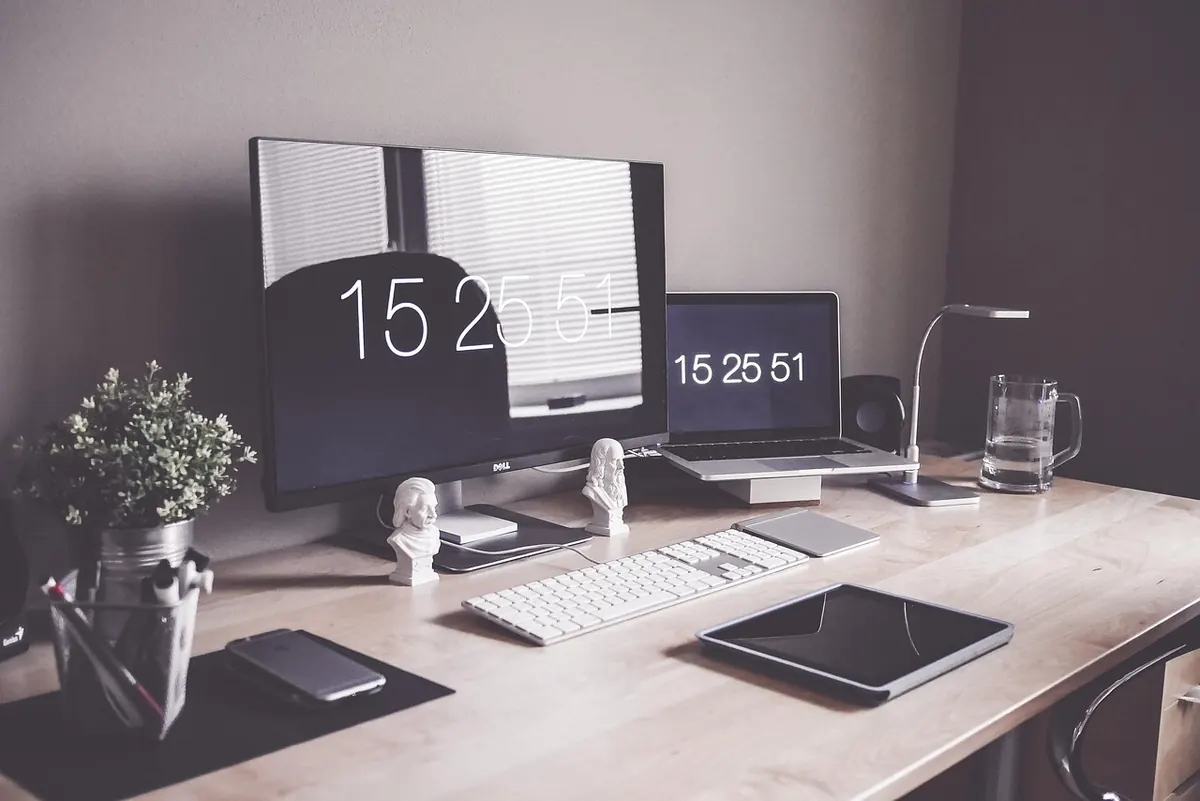
If you use a laptop, raise it so the top of the screen is at or just below eye level, then add a separate keyboard and mouse. A stack of books will do the raising if you would rather not buy a stand. Position the screen about an arm's length away — roughly 50 to 70 centimetres — and tilt it so you are looking slightly down.
If you write on paper as well as typing, keep the page closer to you than the screen. A slanted writing slope or a simple reading stand saves your neck more than you would expect, and it keeps the page in the same pool of light as your hands.
If something hurts
Aches from a poorly arranged desk tend to show up in the neck, shoulders and forearms, and usually ease once you adjust the setup and move about more. Stand up every half hour or so, even briefly. If pain persists, or you have an existing condition, speak to a physiotherapist or another qualified professional rather than working from a general guide.
Build the light in layers
A single ceiling light is the enemy of concentration. It flattens the room, puts glare on the screen and leaves your hands working in their own shadow. Aim for three layers instead.
- Ambient. A soft overhead or corner light that lifts the gloom without landing directly on your desk.
- Task. A desk lamp aimed at the paper or keyboard, bright enough that you are not straining to read.
- Background. A little light behind the screen — a wall light, or a low lamp on a shelf — so your eyes are not switching between a bright rectangle and a dark room.
Where to put the lamp
Put the task lamp on the opposite side from your writing hand so it does not cast a shadow across the page: for a right-hander, that means light from the left. Keep the shade below eye level and tilt it towards the work, not your face. If the desk has a glossy finish, cover the area under the lamp with a mat, because reflected glare is more tiring than dim light. Warmer light suits evening sessions; something cooler and brighter is easier for daytime drafting.
Give every tool a home
Storage is not about volume. It is about knowing where things go, so finding a pen or a folder never becomes a small research project. Think in three tiers.
The first is within arm's reach: the pen you are using, the notebook, a glass of water. The second is a drawer or box for the project you are on now — printouts, index cards, spare ink. The third is out of sight: a labelled box or shelf for archived drafts, old notebooks and the stationery you bought in a fit of enthusiasm. Move things between tiers when a project changes, never mid-session.
Keep only the current project in reach
A desk that holds everything you are working on this year will hold your attention in the same way. If you draft a novel, a newsletter and a client report in the same week, give each one its own folder or shallow tray, and keep one tray on the desk at a time. Swap them when you sit down to choose what to work on, rather than mid-sentence, when you are looking for an excuse.
This is also the moment to decide where the phone lives. A drawer is better than the desk; another room is better still. The same goes for open browser tabs, unread email and household paperwork, which colonise a corner the moment you look away. If you need such things nearby, put them on a shelf behind you rather than beside your line of sight.
Test the setup for a week
Live with the arrangement for a few sessions before you change anything else. Keep a scrap of paper nearby and note what irritated you: the lamp that catches the screen, the drawer that sticks, the chair that creaks, the mug that keeps landing on your notes. Fix one thing at a time, at the end of a session, so you never spend a writing hour rearranging furniture.
Then look after the desk the way you look after the writing. Tidy the surface when you finish — two minutes, not a deep clean — and put the current project back in its tray. Set out what you need for tomorrow before you leave the room. Next time you sit down there is nothing to move and no decision to make, and the writing can start straight away.
Photo: Pexels / Pixabay